Tuesday, October 28, 2014

Taking a Stance Against Bullying


BULLYING: A SOCIAL STUDIES TOPIC


By: Meaghan Brenna Foley

October 28, 2014
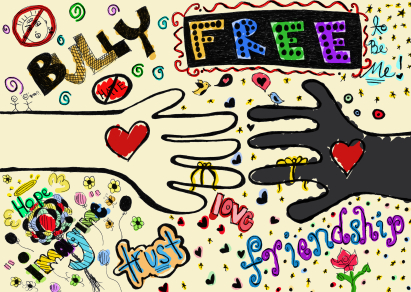

Bullying is a universal issue. People of all ages, races, cultures, and ethnicities experience bullying. In my opinion, bullying is absolutely shameful and should be stomped out of existence. No one should be made to feel inferior by another. We are all human beings who deserve to be respected at all times. I believe that anti-bullying campaigns should be established early on in a child's education. The earlier children learn the difference between right and wrong, the better. There are a number of resources containing activities that teachers could implement in the classroom. I researched a number of educational websites and tools. Below are some of my findings, observations, and comments.


This noteworthy video teaches children, teens, and adults about "netiquette," or playing nice on the internet. It is important to always teach children to use positive words and keep negative thoughts to themselves. Children must develop their pragmatics, or social skills, with others.


October is National Bullying Prevention Month. There are numerous organizations that can participate in bringing about awareness to Stomp Out Bullying. It is especially important for schools to observe October as National Bullying Prevention Month.


 STOMP Out Bullying is a well known organization that seeks to prevent bullying and cyberbullying amongst children and teens in the United States. Some of their influential slogans include: 

STAND UP FOR OTHERS
BE A LEADER
BE KIND
RESPECT OTHERS
BE TOLERANT
HONOR OUR DIFFERENCES
COMPLIMENT A FELLOW STUDENT
ASK THE NEW KID TO JOIN YOU
CELEBRATE OUR SIMILARITIES
BE BRAVE


PACER Center's Kids Against Bullying is another wonderful resource I found that is interactive and allows children to learn about bullying and how they can join the cause. This site also has a discussion forum that allows children (bullies & bullying victims) to post their thoughts and experiences related to the subject of bullying. This interactive site also includes supportive anti-bullying videos from popular children's figures. Other positive elements on the site include quizzes, a petition against bullying, and so much more! I would definitely recommend this site to children of all ages: from elementary school to high school.


Taking the pledge to stomp bullying out of existence should be every child, parent, and teacher's main priority! As a former bullying victim, I proudly take the pledge! :)


In my opinion, bullying should be addressed in unique and age-appropriate ways in order to established   understanding for all grade levels.


GRADES K-3


The Friendship Wreath is a nice interactive activity that I found on Pinterest. Pinterest is such a wonderful tool full of brilliant educational activities! I think that the younger students would really enjoy participating in this activity. This activity promotes unity and friendship; therefore, teaching children to accept each other's differences. :)


GRADES 3+


I think this poster would be beneficial for students starting in Grade 3+. This poster will teach children to always think before they speak. Words can hurt; therefore, always ask yourself: 

Is it true?
Is it helpful?
Is it inspiring?
Is it necessary?
Is it kind?


This poster targets teens and adults on social media: THINK BEFORE YOU POST!


READING 


Reading is another interactive way to bring about awareness associated with bullying. There are many anti-bullying books that could be utilized during any classroom subject (i.e., Social Studies, English, Math, and Science). 


In my opinion, bullying is a very important issue that should not be dealt with lightly! As a future educator, I strongly support all anti-bullying campaigns and organizations. Children need to feel safe and comfortable at school, at home, and in the community.  I will make it my goal to spread the message of equality and acceptance in society to stomp out bullying. :)





Saturday, October 25, 2014

Week 9 Blog (Fieldwork Experience + Current Events)


My Week 9 Blog 

(October 20-October 24)


MONDAY (October 20th)

  • On Monday, a group of my peers taught their cooperative learning lesson to the 2nd grade students at Bishop Dunn Memorial School. In my opinion, they did a wonderful job with addressing each of the 5 PIGS Elements. 


  • The students' social skills were developed through positive interdependence, group processing, and face-to-face interaction. The teachers' assignment of different roles (i.e., manager, writer, reader, illustrator, and reporter) supported the element of individual accountability. However, I think the teachers could have expanded upon the cooperative learning element known as individual accountability. I would have asked my students to stay focused throughout the lesson to give their best efforts towards the group project (i.e. the poster on income, goods, and/or services). Young students need to be continuously monitored and given positive encouragement, especially during group projects. They also need structure, guidance, and repeated instruction.

This group work poster identifies the 6 critical elements of any successful cooperative learning lesson. The key vocabulary words in each element (G.R.O.U.P.S.) are underlined. 


This video above describes the "Jigsaw Project" in great detail. In my opinion, this is the most effective teaching and learning strategy related to the subject of cooperative learning. I think that students learn best when they branch out into separate groups with assigned topics. They also learn about teaching by presenting their findings to their base, or original, groups. 

WEDNESDAY (October 22nd)


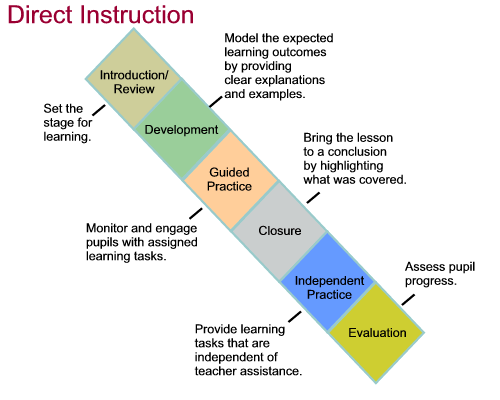
  • This week, Group 2 presented their direct instruction lesson to the 2nd grade students at Bishop Dunn Memorial School. I now have an even greater understanding of direct instruction and can easily identify the 5 key elements: introduction, development, guided practice, closure, and independent practice. I noticed that my peers provided assistance to the students during the independent practice. However, the independent practice is supposed to be just that…independent. Teachers must allow the students to complete an assignment on their own in order to assess their true understanding of the subject matter. 

I think that this labeled picture graphic is the epitome of any direct instruction lesson plan.

FRIDAY (October 24th)

  • On Friday, 2 of my classmates presented their current events presentation. They utilized many different news outlets (i.e., Newsela) and a tool called ThingLink. I think that this tool, along with other tools like Kahoot, would be great to incorporate into any Social Studies lesson. I especially like the ThingLink tool because it allows you to attach links, comments, and other images to objects.

This is a short video tutorial on how to use the ThingLink tool in teaching and learning. I found this video to be extremely helpful.


This is a video on how to utilize the Kahoot tool in the classroom. I love Kahoot! :D I will definitely incorporate this enjoyable activity in my classroom with my future elementary school students. This tool motivates students to enjoy learning. This tool also sharpens the students' concentration, comprehension, and critical thinking skills.


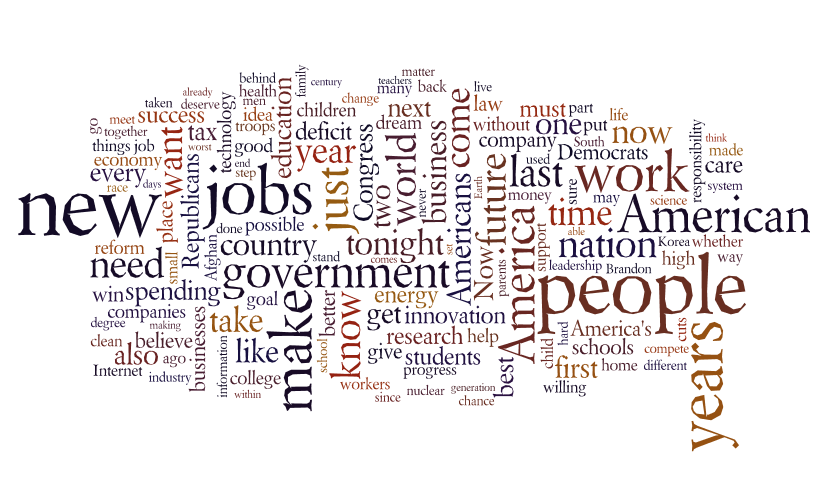
As you can surely tell, I love wordles! :) I think that this is the perfect wordle, which describes the importance of using technology with students in the classroom. 


Tuesday, October 21, 2014

Mount Saint Mary College 2014 Read-a-thon


As a Kappa Delta Pi Honor Society initiate, it is required of me to participate in multiple events that promote literacy and learning. On Saturday, October 18th, I volunteered at Mount Saint Mary College during their 2014 Read-a-thon from 12 to 4 p.m. This event was an absolute success! :) The children had such a wonderful time with their college buddies and were so eager to read more books. The "Tree of Leaves" motivated the children to read as many books as they possibly could! Even us college students got in on the fun and a paper campfire was created! :D The children and college students were given marshmallows, chocolate, and graham crackers for snack. We all had a good time with the children at this reading event! I gained a tremendous amount of teaching experience that I will absolutely use with my future students. Below are some of the pictures I took at the event. Enjoy! :)


The Campfire!--Created by the Mount Saint Mary College Men's Lacrosse Team


Books presented to the students and college buddies for independent reading.


The goal was originally to read 100 books…that goal was surpassed by about 159 books! Combined we all read 259 books!

This was one of my favorite books about a boy who had a bad hair day! ;)
Tents were set up around the room for independent reading! 


This book was so inspiring! It is definitely another one of my favorites about a man and his best friend! 


Campfire Snacks! :D


This books sends the positive message of diversity! I loved it and related to it very much on a personal level! <3 :)


The "Tree of Leaves"

This was such a wonderful and exciting project that motivated everyone to want to read more and more books! As a future elementary school teacher, I plan on doing something like this in my classroom. I think that the young students really enjoyed this! So did I! :) lol 


At the end of the day, the students participated in a raffle and won cool prizes! :) I loved this! In my opinion, positive reinforcement and rewards accelerate a student's love for learning!


Saturday, October 18, 2014

Week 8 Blog (Current Events + Fieldwork Experience)


Week 8 Blog (October 13-October 17)

Monday (13th): 

Meaghan and Joanne's Current Events Presentation     

(Link Attached)

  • On Monday, my partner Joanne and I presented our Current Events presentation. I enjoyed the process of creating this activity because it helped broaden my mind on the concept of research.  I also have a passion for advertising and design; therefore, I found the creation of our group PowerPoint to be quite enjoyable and educational at the same time. For our project, we were given the task of utilizing the Five W's chart (Who?, What?, Where?, When, & Why?) while presenting the class with two news articles found on Newsela (a popular news site). In my opinion, Newsela is a wonderful tool that encompasses such a vast about of news about the everyday world. I appreciate the feedback that Joanne and I received during Monday's class. I acknowledge that we could have expanded upon the wordle in our PowerPoint (pictured above). I would have liked to have gone more in-depth with the wordle; however, I honestly felt that we would not have enough time to finish the lesson activities. Another criticism was a lack of background music in our presentation. Although I do agree that music can be beneficial in the classroom, I felt that it would be distracting and take away from the sole purpose of comprehending the Newsela articles. At the conclusion of our presentation, I came to two very important realizations. For starters, I realized that students sometimes need repeated instruction in order to successfully complete a specified task (i.e., read article #1 for homework). If the students would have read the first article for homework, perhaps Joanne and I would have been able to have expanded upon the discussion of the wordle and how it related to the subject of current events. I also came to the realization that sometimes lesson plans have to be modified to fit the circumstances at hand. Not everything will always go as planned; therefore, a teacher should always have a plan B and be prepared to improvise in the classroom.

THE FIVE W'S IN CURRENT EVENTS

WHO?
  • Who is the important subject (s) in the current event?


WHAT?

  • What are the important details in the current event?


WHERE?

  • Where did the current event take place?


WHEN?

  • When did the current event take place?


WHY?

  • Why did the current event take place?

In my opinion, the Five W's benefit those learning about current events because they act kind of like a checklist. The Five W's serve as reminders of key details, or facts, to remember within a current event (news article).


The video above contains some background information about the Newsela site, which is pertinent to the study of current events.

Wednesday (15th): 

Fieldwork Observation (Inquiry Lesson)


  • On Wednesday, a group of my classmates presented their first inquiry lesson plan to the 2nd grade students at Bishop Dunn Memorial School. The implementation of the inquiry lesson plan was a learning experience for the majority of us, since we are all mainly used to writing up direct instruction lesson plans. I learned a lot about the inquiry process through my observation of the first group's unique teaching styles. I liked how the teachers utilized the "Artifact Bag" project in their inquiry lesson. In my opinion, inquiry is all about investigation and questioning one's thoughts about a particular subject. I think that the teachers did a wonderful job allowing for the students to reflect upon their thinking, both as a group and as an individual learner. It is important for each student to maintain responsibility for the assignment given; therefore, the assignment of roles is critical when dealing with inquiry. All children offer different perspectives on certain key issues present in today's society. With that said, I believe that engagement and creativity are two of the most important elements of any inquiry lesson. Engagement allows for active participation in the lesson and contributes to the student's overall knowledge base. On the other hand, creativity allows for the occurrence of a lively and stimulated classroom discussion. Evidently, an inquiry lesson plan targets cognitive and social development because it deals with thought processes and decision-making conversations. 

Friday (17th): 

  • During Friday's class, I learned about a new tool called VoiceThread. VoiceThread is an innovative technological tool that incorporates voice, sound, video, and other images in a PowerPoint presentation. Two of my classmates used this tool for their current events activity. In addition, the girls incorporated two Newsela articles to read. The girls demonstrated the VoiceThread tool and modeled how to distinguish between a fact (circle it) and an opinion (underline it). Their incorporation of this tool really grabbed the attention of the class and kept us engaged throughout the activity. I will absolutely use and reference my newly created VoiceThread account in my future educational career as an elementary school teacher. I think visual and audio learners could really benefit from the use of this tool in the classroom. Visual learners will benefit from the use of pictures and animation in the slideshow. Audio learners will benefit from the oral instruction included within the VoiceThread presentation. 


The video above demonstrates the step-by-step instructions in creating a VoiceThread account. I found this tutorial to be very helpful and wanted to blog about it for future reference. :)


I found yet another great wordle! This wordle describes the VoiceThread tool just perfectly! Enjoy! :D


Saturday, October 11, 2014

Week 7 Blog (Fieldwork Experience)


WEEK 7 BLOG (October 6-October 10)

By: Meaghan Brenna Foley

  • This week, a few of my fellow classmates presented their direct instruction lesson plan to the 2nd grade students at Bishop Dunn Memorial School. I learned a great deal about direct instruction through my observation of their lesson plan. I now firmly understand that the basic elements of any direct instruction lesson plan include: 1) introduction, 2) development, 3) guided practice, 4) closure, and 5) independent practice. 


The video above represents a direct instruction lesson plan with a central focus on spelling skills. The teacher shows model examples on the board, gives verbal instructions, and helps her students learn spelling skills through a multiple step process. 

1) Introduction
  • In my opinion, the whole purpose of an introduction is to assess the prior knowledge of the students. I also believe that motivation is a critical element that drives direct instruction and gets the students engaged in the lesson.

2) Development
  • In my opinion, the development part of a direct instruction lesson plan should always involve the teacher demonstrating, explaining, modeling, and checking for understanding. I honestly believe that students learn best by example. Examples help students gain a better understanding of a specific topic/subject matter. I think that teachers should also monitor the students' progress, especially during the development phase of direct instruction. Close monitoring will allow for a smoother transition into the guided practice phase of direct instruction.

3) Guided Practice
  • In my opinion, guided practice is the most important phase of a direct instruction lesson.  I think that the guided practice is the most important phase because it involves helping the students develop and master certain skills. I agree with the fact that the guided practice should include multiple activities, ranging from simple to complex. I believe that students master skills when presented with 3-4 age-appropriate activities. In my opinion, the guided practice should allow for the students to both work independently and as a group. Social learning contributes to cooperative learning, which is a significant part of the learning process. 


4) Closure

  • In my opinion, the closure part of the direct instruction lesson plan should always be geared towards the process of review. The closure should involve a simple activity and involve the whole class. After my observation this week, I believe that dividing the class into small groups during the closure is extremely beneficial. Assigning the students special roles, like group leader, makes them feel special and interests them in the activity. Assigning distinct roles is also a part of cooperative learning, where students work together towards a common goal. A whole class discussion should always be the final part of the closure in a direct instruction lesson.


5) Independent Practice
  • In my opinion, the independent practice should be given for the students to complete for homework. In some cases, the independent practice may also be given at the end of class in the form of an exit ticket. Teachers must keep in mind that the independent practice activity should include elements discussed during the development and guided practice. Also, students shouldn't receive any form of assistance during the completion of independent practice. The main purpose of independent practice is to assess the students' knowledge of the topic at the conclusion of the direct instruction lesson.


Sunday, October 5, 2014

Artifact Bag Project/Fieldwork Begins (Week 6 Blog)

Artifact Bag Project/Fieldwork Begins
(Week 6 Blog)

(SEPTEMBER 29-OCTOBER 3)

  • On Monday, my Social Studies Methods class presented and explained the history behind the items in their artifact bags. I liked how we each presented to our individual groups before presenting to the entire class. My group, Group #3, was assigned the task of researching items from the factory to home. My group consists of myself, Nick Marano, and Gina Debenedetto.

MY ARTIFACT BAG


Artifact #1: The Ford Motor Company (Factory)/Rouge Plant-1956
Artifact #2: The '50 Ford By: John Greenya (Published in 1971)
Artifact #3: San Francisco Cable Car Bell-Invented by Andrew Hallidie in 1869 (Owner of a wire-rope factory)
Artifact #4: The Cotton Gin Machine-Invented by Eli Whitney (1825 Painting)

NICK'S ARTIFACT BAG


Artifact #1: Plant Leaves/Twig
Artifact #2: Rock
Artifact #3: Elmer's Glue
Artifact #4: Dollar Bill

GINA'S ARTIFACT BAG


Artifact #1: Compass Rose
Artifact #2: Barrettes (Made in China)
Artifact #3: Picture of people making items.


In my opinion, the Artifact Bag Project is a wonderful way to get students interested in the subject of historical research. This project also stimulates class discussion and social development. Below is a video that I find to be interesting and pertains to the Artifact Bag Project. The child is a pre-kindergartner who is given minimal support during her presentation. The child shares cues to help us guess what items are in her bag. These type of mental cues help develop a child's critical thinking skills, which then benefit research and discovery.


  • On our first day of fieldwork (10-1-14), my classmates and I got acquainted with the 2nd grade students by introducing ourselves to them and sharing one fun fact about ourselves. My fun fact is that I love spending time with my family. :) Many of the children in various groups agreed with me, which warmed my heart. Once we got to know a little bit about our students and vice versa, we assessed our students' prior knowledge on the subject of factories. To my surprise, a number of the students knew a great deal of information about factories. To stimulate group discussion, my partners and I asked the students a few questions like: "What is made in a factory? and Are all factories good?" We asked the second question to help the students relate to and  understand our mentor text, The Lorax. Most of the students knew the background information to this story, which helped them think critically and answer our questions. In the book, there is a factory that cut down trees. We asked the students why this is bad and their answers varied. Some answered, "We need air/oxygen," "The factory is polluting the environment," etc…  I learned a lot about teaching and interacting with my students today. In the future, I will always bring mentor texts and other artifacts to help aid my students' overall success in the classroom.


This is an example of the Artifact Bag Project on the subject of Walt Disney.